H-1B Wage Levels Explained: What Level I-IV Means and Why It Decides Your FY2027 Lottery Odds
DOL sets every H-1B job's prevailing wage at four levels, from Level I (entry) to Level IV (highest). Here's what each level means, how the four floors are calculated, and why - starting with FY2027 - your wage level is also the number of entries your registration gets in the lottery.
Quick answer: Every H-1B job has a prevailing wage set by the U.S. Department of Labor, and that wage is split into four levels - Level I through Level IV - based on the experience and skill a role requires. The levels are set per occupation and per metro area, so the same job title carries different dollar floors in different cities. Starting with the FY2027 registration, the level is no longer just a salary floor: under the new weighted selection rule, your wage level is also the number of entries your registration gets in the lottery, from one entry at Level I to four at Level IV.
What a wage level actually is
When an employer files an H-1B, it must pay at least the prevailing wage for that occupation in that location. DOL's Office of Foreign Labor Certification publishes that wage at four levels, each meant to reflect a different point in a career:
- Level I (entry) - roughly the wage for someone with a basic understanding of the role, often a recent graduate.
- Level II (qualified) - workers who have a good grasp of the occupation.
- Level III (experienced) - solid experience and independent judgment.
- Level IV (fully competent) - the top floor, for senior or specialized work.
The figures come from the 2025-26 prevailing-wage year, which DOL builds on the Bureau of Labor Statistics May 2024 Occupational Employment and Wage Statistics survey.
A worked example: Software Developers in Seattle
Here is the full ladder for one of the largest H-1B occupations in one of its largest metros.
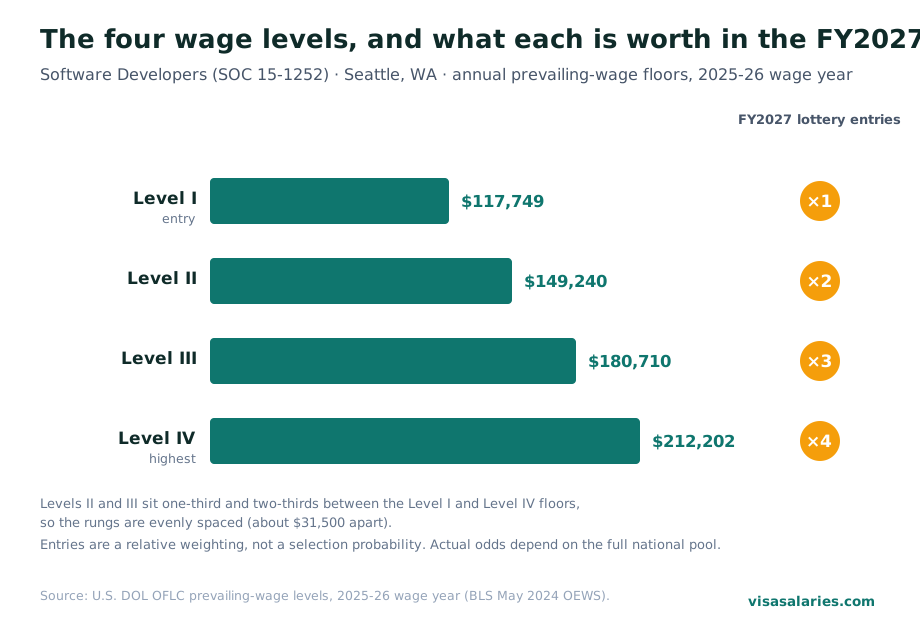
For Software Developers (SOC 15-1252) in Seattle, the annual floors run from $117,749 at Level I to $212,202 at Level IV. The two middle levels are not arbitrary: DOL sets Level II and Level III at one-third and two-thirds of the distance between the Level I and Level IV anchors, a method written into the immigration statute (INA 212(p)(4)). That is why the four rungs are evenly spaced, about $31,500 apart. This even spacing is a property of these authoritative DOL levels; where DOL does not publish leveled wages and the floor is instead derived from filing data, the gaps are not uniform.
Why the level now changes your lottery odds
For the FY2027 cap season, DHS replaced the purely random H-1B lottery with a wage-weighted one. The mechanic is simple: a registration at Level L receives L entries into the selection pool. A Level IV registration gets four entries; a Level I registration gets one.
| Wage level | Lottery entries |
|---|---|
| Level I | 1 |
| Level II | 2 |
| Level III | 3 |
| Level IV | 4 |
This is entry weighting, not a selection probability. Four entries do not mean a four-in-something chance; they mean four times the weight of a single Level I entry. The odds for any level depend on how the whole national pool breaks down across the four levels that year, which is not known until registration closes. To see how different pool assumptions translate into estimated odds, our lottery-odds tool lets you set the baseline rate yourself.
One detail worth knowing: if a worker is registered by more than one employer, the rule counts the lowest applicable wage level, which closes an obvious gaming path.
Same level, different dollars
A wage level is a rank, not a fixed dollar amount. The same Level II means very different pay depending on the occupation and the city. Compare the Seattle software role with a high-volume non-tech occupation in New York:
| Level | Software Developers, Seattle WA | Financial & Investment Analysts, New York NY |
|---|---|---|
| Level I | $117,749 | $87,838 |
| Level II | $149,240 | $118,248 |
| Level III | $180,710 | $148,678 |
| Level IV | $212,202 | $179,088 |
So a "Level III" offer is about $180,710 for a Seattle developer and about $148,678 for a New York financial analyst. Both are Level III; the dollars differ because the underlying wage survey differs.
How to find your own level
To find the level for a specific offer, look up the occupation and metro on its wage page - for example, Software Developers in Seattle or Financial & Investment Analysts in New York - or use our wage-level lookup to see which level a given salary clears.
What could change
DOL has a pending proposal that would raise the wage thresholds for all four levels. If it is finalized, the floors above would move up. Separately, the FY2027 weighted-selection rule (DHS final rule, effective February 27, 2026) is the subject of ongoing litigation. The figures and rules here are current as of June 18, 2026.
FAQ
Does a higher wage level guarantee H-1B selection?
No. A higher level earns more entries - up to four at Level IV - but selection still depends on the full pool of registrations. Entries are a weighting, not a probability. For estimated odds under different assumptions, see the lottery-odds tool.Who sets the four wage levels?
The U.S. Department of Labor's Office of Foreign Labor Certification sets them, using wage data from the Bureau of Labor Statistics OEWS survey. The 2025-26 levels are built on the May 2024 OEWS.Why is the same job a different salary in another city?
Prevailing wages are set per occupation and per metro area, so each city has its own four-level ladder for a given occupation. The level (I-IV) is the same idea everywhere, but the dollar floor reflects local wage data.How are Level II and Level III calculated?
DOL anchors Level I and Level IV from the wage survey, then sets Level II and Level III at one-third and two-thirds of the gap between them, as the immigration statute directs. That is why the four levels are evenly spaced for these official figures.What happens if two employers register the same worker?
The weighted-selection rule uses the lowest applicable wage level among the registrations, so registering at multiple employers does not let a worker claim a higher level than the lowest one on file.Where do these numbers come from?
The wage floors are the official DOL OFLC prevailing-wage levels for the 2025-26 wage year (BLS May 2024 OEWS). Filing counts come from DOL OFLC LCA disclosure data, FY2021-FY2026.In short
H-1B wage levels are DOL's four-step prevailing-wage ladder (Level I entry through Level IV highest), set separately for each occupation and metro from BLS survey data. For Software Developers in Seattle, that ladder runs from $117,749 to $212,202, with evenly spaced rungs because Levels II and III are statutory interpolations of the I and IV anchors. Beginning with FY2027, the level also sets a registration's lottery entries - one at Level I up to four at Level IV - as a relative weighting rather than a selection probability. The same level means different pay in different places, so the practical question for any offer is both which level it clears and what that level is worth where the job sits.