The New Weighted H-1B Lottery (FY2027): How Your Wage Level Now Decides Your Odds
For FY2027, DHS replaced the random H-1B lottery with a wage-weighted system. Here's exactly how the four wage levels change your selection odds — with a plain-English worked example and the FY2027 timeline.
For more than a decade, the H-1B cap lottery was a coin flip. Every eligible registration had the same chance, whether the job paid an entry-level wage or a senior-level one. Starting with the FY2027 cap season, that is over. The selection is now weighted by wage level — and for the first time, the salary an employer offers directly changes the odds of being picked.
This is the single biggest structural change to the H-1B cap in over a decade. Here is what actually changed, how it shifts your odds, and what to do about it.
What changed, in one sentence
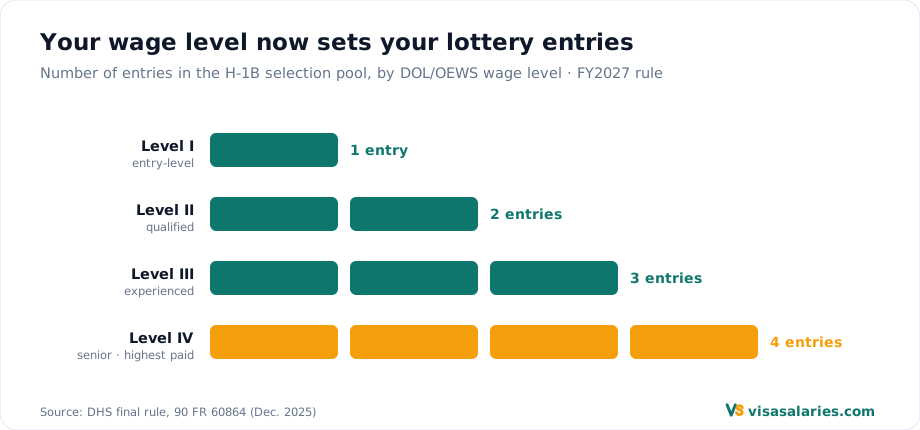
The Department of Homeland Security finalized a rule (effective February 27, 2026) that replaces the purely random lottery with a system that gives more entries to higher wage levels. Higher pay relative to the government's wage benchmark for that job means more tickets in the drawing.
The entries break down like this:
| DOL/OEWS Wage Level | Entries in the drawing |
|---|---|
| Level IV (highest) | 4 |
| Level III | 3 |
| Level II | 2 |
| Level I (entry) | 1 |
The selection is still a random draw — but a Level IV registration now sits in the pool four times, while a Level I registration sits in it once.
What the four "wage levels" actually are
The levels come from the Department of Labor's prevailing-wage system (the OEWS survey). For every occupation in every metro area, DOL publishes four wage benchmarks, roughly tracking experience:
- Level I — entry-level
- Level II — qualified
- Level III — experienced
- Level IV — fully competent / senior
Your level isn't about your title — it's about how the offered salary compares to those four benchmarks for your specific occupation (SOC code) and work location. The same $130,000 salary can be Level IV in one city and Level II in another, because the benchmarks are local.
You can look up the wage levels for any occupation and city, and see what salary crosses into the next level, using our Wage Level Lookup and Wage Threshold tools.
How your odds actually change
The intuitive version: within the same applicant pool, a Level IV beneficiary is up to four times more likely to be selected than a Level I beneficiary.
The honest version has a catch worth understanding. Because higher levels claim more of the entries, the entry-level (Level I) odds fall as the pool fills with higher-weighted registrations. So the effect isn't "Level IV got 4× its old odds" — it's that the whole drawing now tilts toward higher wages, and the lower levels are squeezed.
How much it tilts depends entirely on how many registrations land at each level that year — which nobody knows in advance. That's exactly why an estimate based on historical wage-level distributions is useful for setting expectations.
Want a number for your own situation? Our H-1B Lottery Odds estimator models your selection probability by wage level using the historical distribution of filings. Treat it as an estimate, not a guarantee — the real odds depend on the live pool each season.
The anti-gaming rule: lowest level wins
The system stays beneficiary-centric: one person is one unit in the drawing, no matter how many employers register them. That part hasn't changed since FY2025.
What's new is how multiple registrations interact with the weighting. If the same beneficiary is registered by different employers at different wage levels, USCIS uses the lowest level among them to assign entries. In other words, you can't stack a high-wage registration on top of a low-wage one to game the odds — the floor sets your weight.
What this means for you
If you're a worker / job seeker:
- Your selection odds are now tied to where your offer lands on the local wage scale, not luck alone. A higher offer — or the same offer in a lower-cost metro — can move you up a level.
- Knowing your likely level before registration helps you have a realistic conversation with a sponsoring employer about salary and location.
If you're an employer:
- Wage strategy is now part of cap strategy. The salary, the SOC code, and the work location you register all feed the weight.
- The burden moves earlier — accuracy at the registration stage matters more than ever, and registration, the LCA, and the eventual petition need to stay consistent.
FY2027 timeline (already in effect)
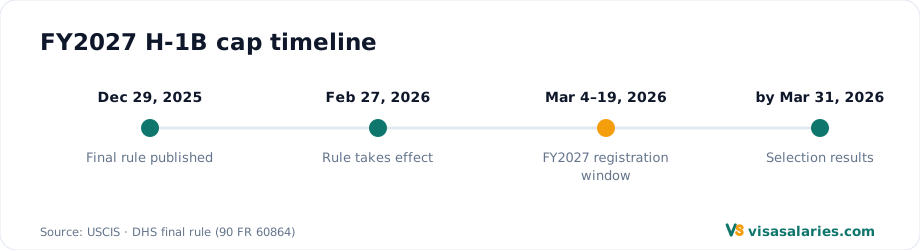
- Dec. 29, 2025 — Final rule published
- Feb. 27, 2026 — Rule effective
- Mar. 4–19, 2026 — FY2027 electronic registration window (the first weighted season)
- By Mar. 31, 2026 — Selection results released
The cap itself is unchanged: 85,000 total — 65,000 regular plus 20,000 reserved for U.S. master's-or-higher degree holders. The registration fee is $215 per beneficiary.
Is the new system permanent?
It's the law of the cap season as of now, and it governed the FY2027 drawing. Opponents have argued that DHS overstepped its authority and that wage level is a poor stand-in for "skill," so litigation is expected to continue. But recent limits on nationwide ("universal") injunctions make a broad pause less likely, and no court has blocked the weighted process as of this writing. We'll update this page if that changes.
Estimate your own odds
The fastest way to see where you stand:
- Find your wage level for your occupation and city.
- See what salary reaches the next level — sometimes a modest bump changes your weight.
- Estimate your selection odds by wage level.
You can also browse real, disclosed H-1B salaries by employer to benchmark an offer against what companies actually pay.
Sources: U.S. Department of Homeland Security final rule, "Weighted Selection Process for Registrants and Petitioners Seeking To File Cap-Subject H-1B Petitions," 90 Fed. Reg. 60,864 (Dec. 29, 2025); U.S. Citizenship and Immigration Services, H-1B Electronic Registration Process. Wage levels reference the Department of Labor OEWS prevailing-wage system. This article is general information, not legal advice.