The $100,000 H-1B Fee, Struck Down — For Now: What the June 8 Ruling Changes (and What It Doesn't)
A federal judge vacated the $100,000 H-1B fee nationwide on June 8, 2026, calling it a tax only Congress can levy. The government is appealing, a June 12 stay has since reinstated the fee pending appeal, and the FY2027 weighted lottery is untouched. Here is what actually changes.
Quick answer: On June 8, 2026, a federal judge in Boston struck down the $100,000 fee on new H-1B petitions, ruling it a tax that only Congress can impose, and vacated it nationwide, effective immediately. The government says it will appeal, and it can ask the courts to pause the ruling while the appeal runs; if that request is granted, the fee could come back. One thing the decision does not touch is the FY2027 wage-weighted lottery, which comes from a separate rule and separate litigation.
Update (June 22, 2026): The picture has shifted since this was published. On June 12, 2026 the same court temporarily paused its own June 8 order while the government appeals, so USCIS is once again allowed to collect the $100,000 fee on new H-1B petitions that require consular processing. The government has appealed to the First Circuit (State of California v. Mullin, No. 26-1699) and asked the appeals court to keep the fee in place during the appeal. A separate court in Washington, D.C. had earlier upheld the fee, and that case is on appeal too, so the issue may eventually reach the Supreme Court. For anyone filing now, the practical takeaway is to treat the fee as in effect and confirm the current status with counsel. The June 8 holding described below still stands as the court's reasoning; it is paused, not reversed.
What the court actually decided
The fee arrived by presidential proclamation on September 19, 2025: $100,000 per new H-1B petition, on top of filing costs that had typically run somewhere between $2,000 and $5,000. Twenty state attorneys general sued. On June 8, U.S. District Judge Leo Sorokin sided with them on summary judgment and vacated the requirement in a 42-page decision.
The core of the ruling is blunt. Whatever the proclamation calls the payment, the court found, "it is a tax, regardless of what the payment is called," and taxing is Congress's job. Sorokin leaned on the Supreme Court's February decision striking down the administration's emergency-powers tariffs on the same logic: duties imposed by the executive are taxes for constitutional purposes. The decision also held that the fee exceeded the statutory authority the administration invoked, and that it failed the Administrative Procedure Act as both procedurally deficient and arbitrary and capricious. Three independent grounds, any one of which would have been enough.
The White House disagrees in the plainest terms. A spokeswoman said the administration is confident the order will be reversed on appeal, arguing the president has clear authority to restrict the entry of any class of noncitizens he judges contrary to American interests.
What changes today
Immediately after the ruling, USCIS could not collect the $100,000 payment, though a later stay has since allowed collection to resume (see the update above). The practical effect is smaller than the headline number suggests: as of February 15, the agency had received exactly 85 payments of the fee, according to a USCIS official's March court filing. The main reason is an exemption. The fee never applied to people already in the United States on student visas, who make up a large share of new H-1B recipients. Most employers, in other words, structured around the fee rather than paying it.
The ruling says nothing about refunds for the payments that were made. That question is open.
What doesn't change: the weighted lottery
The June 8 decision is about the fee and only the fee. The FY2027 selection rule, which weights lottery entries by OEWS wage level — one entry for Level I, up to four for Level IV — is a separate DHS regulation, challenged in separate litigation, and it remains in effect. Every wage page on this site still shows the entry weighting an offer would earn, the mechanics are in our earlier explainer on how the FY2027 weighted selection works, and the wage level lookup classifies any offer against any area's official floors.
The litigation isn't over
Two things are worth watching.
First, the stay question. The government can ask the courts to put the June 8 ruling on hold while the appeal proceeds. If a stay is granted, the fee returns for the duration of an appeal that could last a year or more.
Second, the courts disagree with each other. In December, a federal judge in Washington, D.C. came out the other way, rejecting the U.S. Chamber of Commerce's challenge and holding that the fee fell within the president's immigration powers. That appeal was put on a fast track, with arguments set for February. Conflicting rulings in two circuits are precisely the setup that tends to draw Supreme Court review.
We are not going to predict where this lands. Both rulings are public; the timeline is not.
A measurement, not a forecast
Our H-1B Barometer, the Monthly U.S. Immigration Donut Index, exists for moments like this. It compresses visa-bulletin movement, PERM processing times, lottery selection rates, and tech-hiring signals into a single monthly reading of current conditions, on a 0–100 scale. The latest reading is 33 (Cold), down 3 points from the prior month. June 8 will appear on its chart the way September 19 did: as a marker on the timeline, not a prediction about what follows. The next monthly reading lands later this month.
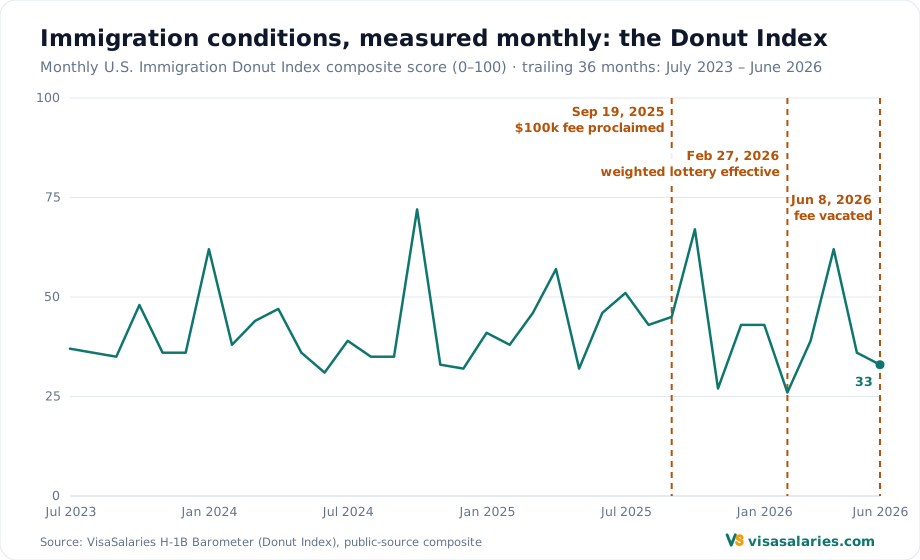
The index is a measurement of current conditions, not a prediction — about this case or anything else. If your green-card timeline depends on a specific category and country, the personal calculator on the Barometer page scores your position against the queue's recorded history.
Status, sources, caveats
Status as of June 22, 2026: the June 8 ruling vacated the fee, but the court stayed its own order on June 12 while the government appeals to the First Circuit, so USCIS may collect the fee again for now. A separate D.C. court had upheld the fee, and that appeal is also pending. Confirm the current status before relying on any single figure. Litigation is ongoing and this page describes a moving target — check the current status before acting on it. Facts above come from the June 8 decision and contemporaneous reporting, a USCIS court filing from March (the 85-payment figure), Proclamation 10973 (September 19, 2025), and the DHS FY2027 selection rule (effective February 27, 2026). Index data: this site's Barometer, built monthly from public sources. Sources and definitions: About.